Alpha Centauri Lab
Your Mission Begins Beyond the Solar System
Explore Alpha Centauri A, Alpha Centauri B, Proxima Centauri, distant planets, interstellar travel, robotic exploration, astronomy, and spacecraft engineering through interactive missions led by Pepe the Robot.
Alpha Centauri Exploration Lab™
Journey to Our Nearest Neighboring Star System
The Alpha Centauri Exploration Lab combines real astronomy, simplified educational simulations, robotics, engineering, and creative exploration. Some activities are scientific models or creative speculation and should not be interpreted as confirmed discoveries.
How far away is Alpha Centauri?
The Alpha Centauri star system is about 4.37 light-years from Earth. Proxima Centauri, the closest star in that system, is about 4.24 light-years away.
Light-years
4.37
Distance to Alpha Centauri
Kilometers
41.3T
About 41.3 trillion kilometers
Miles
25.7T
About 25.7 trillion miles
Even traveling at the speed of today’s fastest spacecraft, the trip would take tens of thousands of years, which is why scientists study future propulsion ideas and robotic missions.
Portal ambient music
Soft space-inspired music plays while exploring the Alpha Centauri portal.
Animated star map
Explore the Alpha Centauri system in its own visual block.
Futuristic Alpha Centauri Gallery
A visual glimpse into the next generation of interstellar discovery.
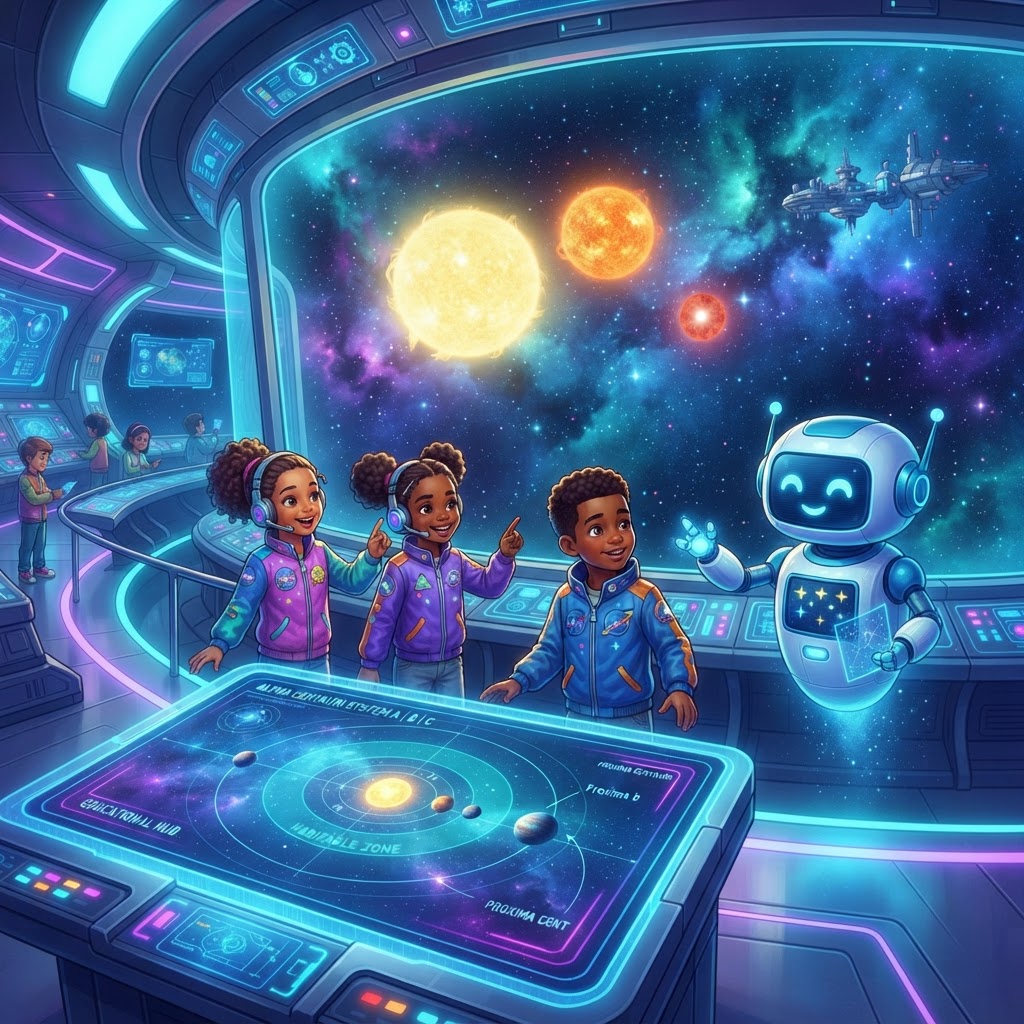
Triple-Star Observatory
A glowing observatory view where young explorers study the Alpha Centauri system with futuristic star maps.
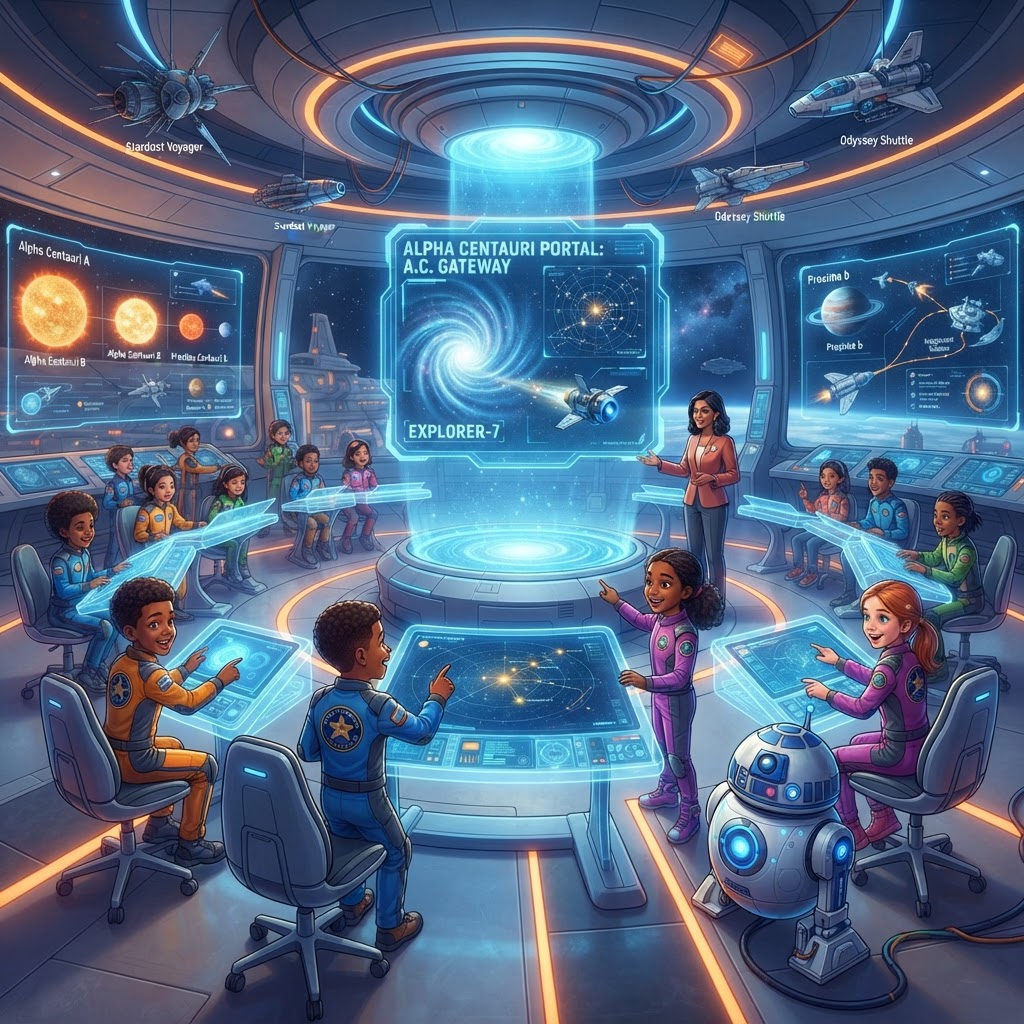
Mission Control Future
A high-tech learning command center where students and robots guide interstellar science missions together.
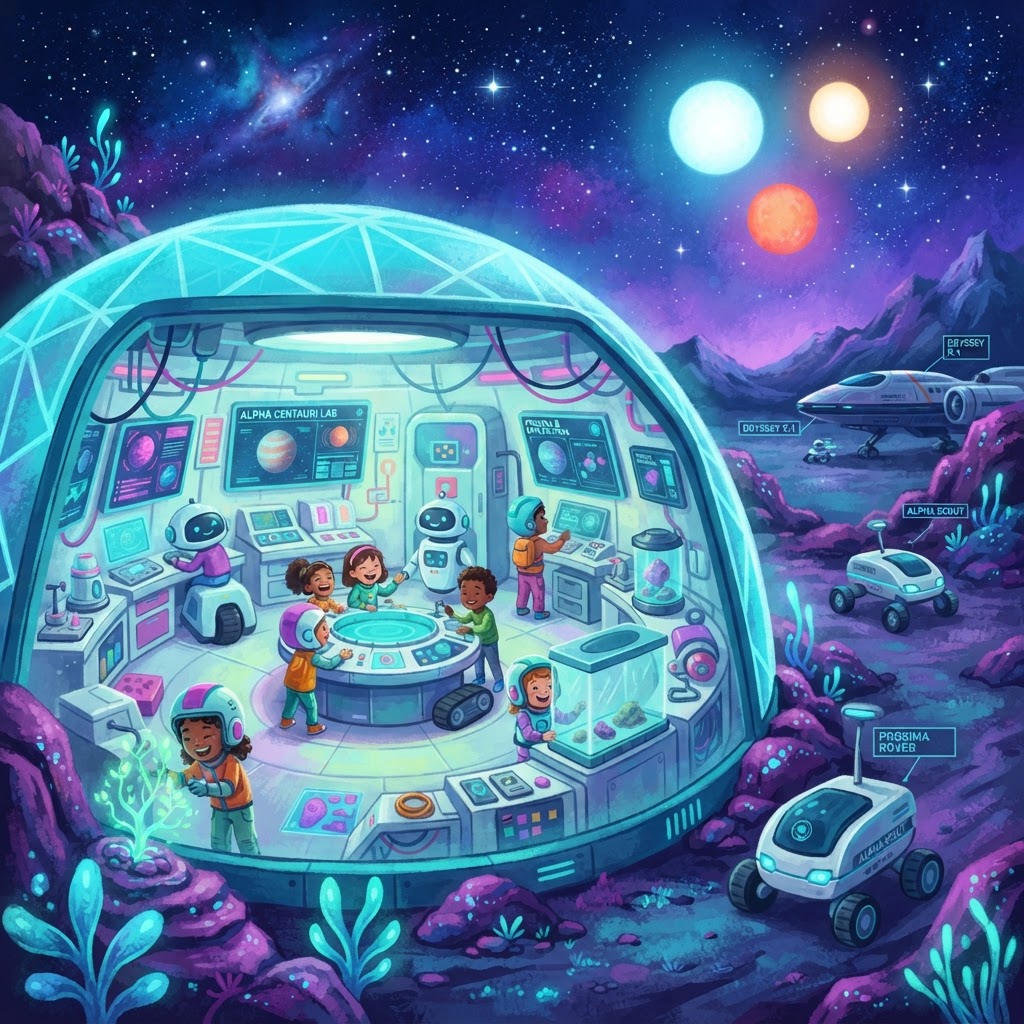
Robot Explorer World
A futuristic alien-world lab where robotic explorers investigate the wonders of distant planets.
PEPE MISSION COMMANDER
Welcome, space explorer!
Welcome, space explorer! I’m Pepe, your mission commander. Together, we will travel beyond our solar system, explore the stars of Alpha Centauri, design spacecraft, build robots, study distant planets, and solve the challenges of interstellar travel. Prepare for launch!
Main laboratory areas
Choose a lab to open its learning space, tools, and launch content.
Alpha Centauri Observatory
Compare the three stars, orbit paths, colors, and distances in a labeled educational model.
Three-Star System Simulator
Adjust simplified star and planet settings to see habitability, radiation, and stability changes.
Proxima Planet Laboratory
Study Proxima Centauri b, compare it with Earth, and test atmosphere and flare scenarios.
Interstellar Travel Center
Calculate how long missions could take and why Alpha Centauri travel is so challenging.
Spacecraft Design Center
Choose spacecraft systems, organize payloads, and score your mission design.
Robot Explorer Workshop
Design a robot explorer and build a simulation-only command plan for distant worlds.
Mission Control
Guide launch, travel, emergencies, and final exploration with mission decisions.
Telescope and Light Laboratory
Learn how light, color, spectra, and planet detection help scientists study distant systems.
Life Beyond Earth Laboratory
Separate evidence from imagination while testing the conditions that may support life.
Alien World Creator
Design creative worlds, habitats, robots, and landscapes clearly labeled as speculation.
Space Communication Center
Practice encoding messages, handling delays, and repairing weak deep-space signals.
Space Weather Laboratory
Simulate stellar flares, shielding, disruption, and emergency shelter decisions.
Student Research Center
Organize notes, project ideas, mission reports, and teacher-ready presentation concepts.
Mission Achievement Hall
Celebrate badges, discoveries, spacecraft designs, robot builds, and mission milestones.
Active lab experience
Current lab: Alpha Centauri Observatory
Educational model • not to scale
Alpha Centauri A
Color: Golden white
Size: Sun-like
Temperature: About 5,800 K
A bright Sun-like star in the binary pair.
Star-identification activity
Question: Which star in this model is the smallest red dwarf?
Hint: It is cooler, redder, and much smaller than the two main stars.
Launch content
Meet Alpha Centauri A, Alpha Centauri B, and Proxima Centauri in a simplified educational star-system model.
- • Meet the Three Stars
- • Star Colors and Temperature
- • What Makes a Binary Star?
- • How Far Is a Light-Year?
- • Star or Planet?
Pepe audio script: Mission explorers, today we are studying three nearby stars. Watch their colors, brightness, and distance labels carefully.
Interactive activity: Tap each star to compare size, temperature, color, and orbit notes.
Quiz: Which star in this model is the small red dwarf?
Badge: Star Spotter Badge
Project: Create a comparison chart for Alpha Centauri A, B, and Proxima Centauri.
Celebration: Pepe awards a glowing constellation burst for completing the observatory lesson set.
Age-based learning tracks
Little Space Explorers
- • Meet the three stars
- • Count the planets
- • Color a spacecraft
- • Help Pepe pack for space
- • Build a friendly robot
- • Match stars and colors
- • Launch a toy rocket
- • Complete a space story
Junior Astronomers
- • What is a light-year?
- • The three Alpha Centauri stars
- • Proxima Centauri b
- • How telescopes work
- • Build a robotic probe
- • Design a spacecraft
- • Complete a mission
- • Create a science report
Young Space Engineers
- • Orbital mechanics concepts
- • Star classification
- • Exoplanet detection
- • Spacecraft systems
- • Interstellar propulsion
- • Robotics programming
- • Mission risk analysis
- • Communication delay
- • Final engineering project
Advanced Alpha Centauri Research
- • Spectroscopy
- • Stellar activity
- • Planetary atmospheres
- • Habitability modeling
- • Autonomous robots
- • AI mission control
- • Scientific uncertainty
- • Research writing
- • Data analysis
- • Advanced mission design
Course structure
Introduction to Alpha Centauri
- 1. Our Place in Space
- 2. The Sun and Nearby Stars
- 3. Alpha Centauri A
- 4. Alpha Centauri B
- 5. Proxima Centauri
- 6. Understanding Light-Years
- 7. The Three-Star System
- 8. Alpha Centauri Quiz
Proxima Centauri and Its Planets
- 1. Red Dwarf Stars
- 2. Proxima Centauri
- 3. Proxima Centauri b
- 4. Habitable Zones
- 5. Planetary Atmospheres
- 6. Stellar Flares
- 7. Compare Earth and Proxima b
- 8. Planet Research Project
Build an Interstellar Spacecraft
- 1. Mission Requirements
- 2. Spacecraft Structure
- 3. Propulsion
- 4. Power
- 5. Navigation
- 6. Communications
- 7. Shielding
- 8. Scientific Instruments
- 9. Robot Payload
- 10. Final Spacecraft Design
Build a Robot Explorer
- 1. What Space Robots Do
- 2. Robot Mobility
- 3. Robot Sensors
- 4. Robot Cameras
- 5. Robot Power
- 6. Communication
- 7. Hazard Avoidance
- 8. Data Collection
- 9. Robot Programming
- 10. Final Robot Mission
Alpha Centauri Mission Control
- 1. Mission Planning
- 2. Launch
- 3. Interstellar Travel
- 4. Emergency Response
- 5. Arrival
- 6. Probe Deployment
- 7. Planetary Study
- 8. Data Transmission
- 9. Mission Report
- 10. Final Mission Review
Searching for Life
- 1. What Life Needs
- 2. Water
- 3. Atmospheres
- 4. Energy
- 5. Radiation
- 6. Biosignatures
- 7. Scientific Evidence
- 8. Speculation Versus Fact
- 9. Build a Habitable World
- 10. Final Science Conclusion
First launch lessons
Meet the Three Stars
Difficulty: Easy
Learning objectives
- • Name the three stars
- • Spot star colors
- • Tell a star from a planet
Key vocabulary
star, binary, red dwarf
Mission task
Identify Alpha Centauri A, B, and Proxima Centauri.
Notes area
Completion star ready ★
What Is a Light-Year?
Difficulty: Easy
Learning objectives
- • Explain a light-year
- • Compare nearby stars
- • Estimate travel difficulty
Key vocabulary
distance, light-year, travel time
Mission task
Use the travel meter to compare mission lengths.
Notes area
Completion star ready ★
Explore Proxima Centauri b
Difficulty: Medium
Learning objectives
- • Compare Earth and Proxima b
- • Test atmosphere changes
- • Describe flare risk
Key vocabulary
habitable zone, radiation, atmosphere
Mission task
Generate a planet report with one safety recommendation.
Notes area
Completion star ready ★
Build Your First Spacecraft
Difficulty: Medium
Learning objectives
- • Select key systems
- • Balance safety and science
- • Choose a payload
Key vocabulary
propulsion, shielding, payload
Mission task
Save a spacecraft concept for teacher review.
Notes area
Completion star ready ★
Design a Planetary Robot
Difficulty: Medium
Learning objectives
- • Choose mobility
- • Add sensors
- • Plan commands
Key vocabulary
sensor, relay, sample
Mission task
Create a robot that can scan, collect, and return.
Notes area
Completion star ready ★
Complete Your First Alpha Centauri Mission
Difficulty: Medium
Learning objectives
- • Respond to hazards
- • Protect spacecraft health
- • Complete the mission report
Key vocabulary
midcourse correction, signal delay, radiation
Mission task
Finish a full mission run with a passing score.
Notes area
Completion star ready ★
Dashboards and management previews
Student Dashboard
- • Welcome message
- • Current mission
- • Course progress
- • Spacecraft saved
- • Robots saved
- • Quiz scores
- • Recommended next activity
Parent Dashboard
- • Child progress
- • Time spent learning
- • Projects
- • Certificates
- • Favorite activities
- • Teacher comments
- • Voice and screen-time controls
Teacher Dashboard
- • Create classes
- • Assign lessons and missions
- • Review spacecraft and robot designs
- • Grade projects
- • Issue badges and certificates
- • Host mission presentations
Administrator Controls
- • Manage courses and lessons
- • Manage missions and simulations
- • Manage parts, badges, voice settings, scientific updates
- • Reports, analytics, moderation, and safety notices
Certified Alpha Centauri Explorer
Kids & Robots educational certificate preview with student name, completion date, certificate number, QR verification code, course title, instructor, Pepe image, Kids & Robots logo, and McZeal Robotics logo.
- • Complete required lessons
- • Pass course quizzes
- • Complete one spacecraft design
- • Complete one robot design
- • Finish a mission simulation
- • Submit the Mission Alpha Centauri Challenge™ capstone project
Special events
- • Alpha Centauri Mission Day
- • Family Space Night
- • Junior Astronomer Graduation
- • Robot Rover Challenge
- • Spacecraft Design Competition
- • Exoplanet Discovery Night
- • Telescope Night
- • Space Science Fair
- • Interstellar Art Show
- • Student Mission Presentation
- • Build-a-Robot Day
- • Space Career Day
Pepe can host intros, lead countdowns, present awards, announce students, and close graduation activities.